
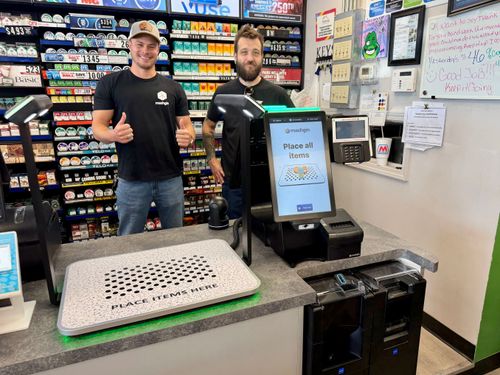
Is Mashgin worth the extra cost compared to traditional self-checkout machines like NCR?#
For high-volume stores, yes. Traditional self-checkout makes shoppers scan every item themselves and often can't handle age-restricted items, hot food, or lottery without staff. Mashgin rings up everything on the tray at once, supports nearly every transaction type, and keeps a cashier in the loop. It costs more per unit, but operators typically recover the cost within months through higher sales and labor efficiency. Mashgin's research on convenience store lines found that long lines cost a typical store $65 to $100 in lost profit per day (roughly $200 to $300 in lost revenue), money that faster checkout lets stores recapture.
| Traditional barcode self-checkout | Mashgin AI checkout | |
|---|---|---|
| How items are identified | Shopper scans each barcode | Cameras identify every item on the tray at once |
| Items without barcodes (hot food, produce, fountain drinks) | Manual lookup or code entry | Recognized visually |
| Alcohol and tobacco | Usually restricted or requires staff approval | Supported. The kiosk pauses for an attendant ID check |
| Who does the work | The shopper | The AI, with a cashier nearby to assist |
| Checkout time | Depends on cart size and scanning skill | 11–18 seconds in Mashgin case studies |
What is the best self-checkout technology?#
Most traditional self-checkout systems work the same way: a barcode scanner plus manual lookup for everything else. Choosing among them mostly comes down to price and how well they integrate with your existing systems.
The main recent change in the category is AI-based checkout, which identifies items with cameras instead of barcodes. Mashgin invented and patented multi-camera 3D computer vision for item recognition. It runs in 5,000+ locations, including convenience stores, 65% of professional sports stadiums, hospitals, universities, and airports.
Why hasn't self-checkout technology improved?#
Grocery self-checkout has changed little in years because it's still built around scanning barcodes one at a time. Most of the change has come in convenience stores, stadiums, cafeterias, and micro markets, where computer vision checkout lets shoppers place all their items on a tray, pay, and go. Mashgin invented this approach and has the largest installed base. Its monthly transactions grew from 3 million in March 2022 to 40 million in March 2025, and it has processed more than 1.7 billion total transactions. It now has more than 44 million unique monthly active users (based on Mashgin’s internal product usage data).
Do customers actually use self-checkout?#
Many do, but opinions are split. Some shoppers like the independence. Others see traditional self-checkout as shifting the cashier's work onto them, and it can be clumsy for non-barcoded items.
AI checkout removes the scanning step, which changes shopper sentiment. In Mashgin's 2026 survey of 2,500 U.S. convenience store shoppers, 85% preferred Mashgin over traditional checkout. Mashgin also supports almost every in-store transaction type: cash, alcohol, nicotine, EBT, fuel, and hot food.